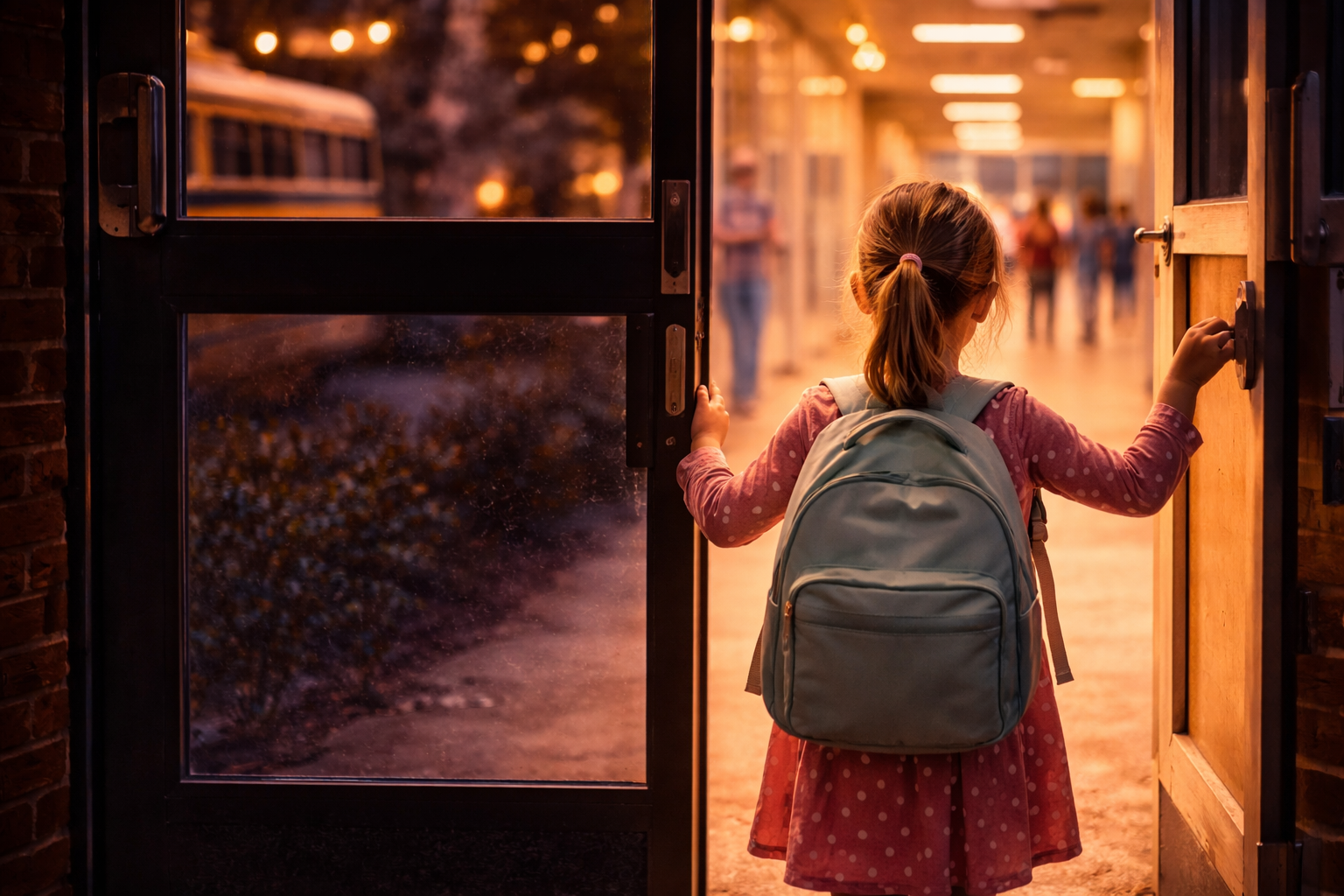
There's a particular kind of quiet that settles over a house the evening before something big. The school uniform is laid out. The dentist appointment is in the morning. The new baby is arriving this week. And your child — who may have seemed fine about it all day — starts to unravel at bedtime.
It makes sense. Bedtime is when small children run out of distraction. The busyness of the day falls away and whatever has been sitting at the back of their mind moves to the front. For a four-year-old who has never been to a dentist, or a five-year-old who doesn't know a single person in their new class, that thing at the back of their mind is large and shapeless and doesn't have a name yet.
What children that age need — what all of us need, actually — is a story that gives the fear a shape. Something they can look at, process safely, and find their way through before it's real. That is what storytelling has always been for. Long before bedtime apps and children's publishing, stories were how human beings rehearsed difficult experiences in safe conditions.
The night before is a good moment to use it.
Narrative is how children's brains make sense of the unknown
Child psychologists have long understood that young children process anxiety through play and story rather than through direct conversation. A child who cannot articulate "I'm afraid of the dentist" can follow a story about a brave character who visits one — and in doing so, rehearse the emotions, the sequence of events, and the resolution. Research in developmental psychology describes this as "bibliotherapy" — using narrative to prepare children for difficult experiences — and it has been applied in clinical settings for first hospitalisations, medical procedures, bereavement, and major life transitions. The child watches someone like them go through it. That's enough.
Why the night before works better than the morning of
Most parents' instinct is to talk about a big event on the day — in the car on the way, over breakfast, as you're walking up to the school gate. That's understandable, but it's often the hardest moment for a child to take anything in. Their nervous system is already activated. They are in the middle of the experience, not before it.
The night before is different. Your child is calm, in their familiar bed, in their familiar routine. Their brain is in exactly the state that is most receptive to story — relaxed attention, low threat, high imagination. A story that introduces the theme of tomorrow in a safe, resolved narrative lands very differently at 7:30pm than a conversation at 7:30am.
It also gives the story time to do its work overnight. Sleep is when the brain consolidates what it has processed. A child who hears a story about bravery before a dentist visit and then sleeps on it wakes up with something their brain has already begun to make sense of.
You're not trying to remove the fear. You're giving your child a story where someone like them felt that fear — and got through it anyway.
The big firsts — and what each one needs
Not all big moments are the same. What a child needs the night before their first dentist appointment is different from what they need before starting school. Here's how to think about each one — and what kind of story actually helps.
The first dentist visit
The dentist is frightening for small children for a specific reason: it combines strangers, an unfamiliar environment, lying down in a vulnerable position, and strange tools near their face — all at once. They have no frame of reference for any of it. And because they can't yet fully understand explanations, telling them "it won't hurt" or "it's nothing to worry about" rarely helps. What they need is a story that shows them what happens, in sequence, with a character who feels nervous and comes out fine.
The most effective preparation stories for dentist visits include the sequence of events (the chair goes back, there's a light, the dentist counts your teeth), the sensory details (it might feel cold, there might be a funny noise), and a moment where the character feels brave rather than simply not scared. The distinction matters: brave doesn't mean unafraid, it means doing it even though you're afraid. That framing is far more useful to a child than pretending there's nothing to worry about.
Your child's character travels deep into the Stardust Mountains, where the wise Mountain Keeper checks everyone's teeth to keep them strong and gleaming — using a tiny magic mirror and a soft counting wand. Your child feels a little fluttery inside, but the Mountain Keeper is gentle and kind, and afterwards they get a sticker of a shining star and feel very proud. Tomorrow, when the real dentist does the same thing, your child already knows how the story goes.
First day at school
Starting school is one of the biggest transitions in a young child's life. It's not just one fear — it's several layered on top of each other. Will Mum or Dad come back? Will anyone want to play with me? What if I don't know what to do? What if I need the toilet and I don't know where it is? These are not irrational fears. They are entirely reasonable responses to a genuinely new situation, and dismissing them with "you'll be fine!" tends to make children feel more alone with the feeling, not less.
What helps is a story where the character arrives somewhere new and unfamiliar, feels uncertain, finds one small moment of connection — a shared interest, a kind word from a teacher, a funny thing that happens — and by the end feels that this new place might be okay. Not perfect. Not magically wonderful. Just okay. Children can hold onto that.
Your child's character arrives at the Dreamy Mushroom Village for the very first time. Everything is new and a little bit big — the winding paths, the colourful doors, the strangers going about their day. But the village elder has kind eyes, and at the morning gathering, your child discovers that the creature sitting next to them also loves the same thing they love. By lunchtime, they've made one friend. One is enough. Tonight's story ends there — quietly, warmly, with the message that new places become familiar, and one friend is a good place to start.
A new baby sibling
The arrival of a new sibling is a unique kind of big event because it doesn't have a clear endpoint — it's not something that happens and then is over, it's something that changes everything, permanently. Children often don't have the language to express what they're actually feeling, which is something close to grief for the life they had before. That's a lot for a small person.
A story that helps here isn't about the new baby being wonderful (children don't believe that yet). It's about the older child being special — specifically special, in ways that are theirs alone — and about love not dividing when it grows, but expanding. Stories that focus on what only the older child can do, what only they understand, what only they share with their parents, are far more reassuring than stories that simply tell them everything will be fine.
Your child's character is the keeper of a magical lantern that only they know how to carry. When a new small creature arrives in the land, everyone is busy — but only your child knows the old songs, the favourite paths, the secret spots. The story gently shows that new arrivals don't erase what came before. They add to it. Your child ends the night as the one who knows things no one else does yet — and that is a very important thing to be.
Moving to a new home
For children, home is not an address. It is a collection of sensory anchors — the particular light through their bedroom curtains, the creak of a specific step, the garden they know by heart. Moving removes all of those at once. It can feel, to a young child, like a kind of erasure. Even if the new place is objectively better, that is not yet the experience — the experience is loss.
The most useful story for a child facing a move is not one that tells them the new house will be great. It's one that acknowledges what they're leaving, carries it forward, and shows that the things that matter — the relationships, the memories, the objects they love — travel with them. Home, the story suggests, is something you bring rather than something you leave behind.
Your child's character must leave the Candy Forest where they've always lived. They're sad about the old sugar-oak tree, the wobbly gate, the exact way the light falls on the path home. But as they pack their bag, they realise they're taking all of it with them — in the stories they carry, the things they remember, the person they've become in that place. Starfire Meadow, where they're going, has different colours in the sky. And that's a little exciting, actually, now that they think about it.
A hospital visit or medical procedure
Medical procedures are among the most anxiety-inducing experiences for young children, and also among the hardest to prepare them for, because the full truth of what will happen may itself be frightening. The research on paediatric anxiety is clear: children who are prepared with age-appropriate information and narrative — rather than being surprised — experience significantly less distress during and after procedures.
Bibliotherapy has been used formally in hospitals for decades to prepare children for surgery, injections, and other procedures. The principle is simple: a character who looks like the child, feels what the child feels, goes through something similar, and comes out the other side safely. It doesn't promise that it won't hurt. It promises that it ends. And that the child is still whole and themselves afterwards. That is enough.
Your child's character visits Moonpool Corner, where the gentle keepers of the pool tend to everyone who needs looking after. Your child feels nervous — it's big and a little unfamiliar. But the keepers explain everything before they do it, and your child's person is always right there beside them. Afterwards, your child's character is given a golden sticker and a warm, sweet drink, and they feel proud of themselves for being so brave. They were scared. And they did it anyway. Those two things can both be true.
Starting nursery or a new childcare setting
For very young children, the primary fear of starting nursery is separation — the moment when their parent leaves. Everything else is secondary. What matters most in the story here is not reassurance about the nursery itself (toys, friends, activities) but reassurance about the return. Mummy comes back. Daddy comes back. Every single time. That's what a young child needs to hear repeated, not explained.
Stories that help with separation anxiety are ones where the character is left somewhere, feels the feelings, discovers something interesting, and then — reliably, certainly — has their person walk back through the door. The ending is not a surprise. The story makes the ending feel inevitable. That reliability is exactly what the anxious child's brain needs to hear.
Your child's character arrives at a warm and busy place full of interesting things. When their grown-up has to leave for a little while, your child feels a wobble in their tummy. But then there's a kind helper, and a box of interesting things to explore, and time passes. And then — as it always does, as it always will — their grown-up walks back through the door with a big smile and open arms. The story ends the same way, every time it's told. That is the point.
How to use a story this way — practically
You don't need to make this elaborate. The night before a big first, the story doesn't need a lengthy introduction or a discussion beforehand. Just choose a theme that mirrors tomorrow, settle into the normal bedtime routine, and let the story do its work quietly.
The night before
- Normal bedtime routine — no drama
- Choose a story with a matching theme
- Don't explain why you chose it unless they ask
- Let the story end without discussion
- If they bring it up, follow their lead
- A simple "that character was brave, wasn't they" is enough
The morning of
- Refer back briefly if helpful: "like in last night's story"
- Don't over-talk it — keep energy calm and matter-of-fact
- Let them lead the conversation about it
- Validate the feeling: "it's okay to feel nervous"
- Remind them the story character got through it
- And so will they
Instead of: "There's nothing to be scared of" — which tells the child their feeling is wrong.
Try: "It makes sense to feel nervous about something new. Let's read a story about someone who felt like that too."
Instead of: "You'll be fine, I promise" — which puts pressure on them to perform being fine.
Try: "Brave doesn't mean not scared. It means doing it even when you're a little scared. That character in last night's story was brave."
Instead of: Over-explaining or reassuring at length — which can amplify rather than soothe anxiety.
Try: Keeping it simple. The story has already done the work. Your calm presence at bedtime does the rest.
How Dreamland makes this easy
With Dreamland, you don't have to find a story that happens to cover the right theme, or adapt something that doesn't quite fit. You choose the theme — bravery, new beginnings, being looked after by kind strangers, saying goodbye and being reunited — and Dreamland generates a story built around your child's own character, set in one of their familiar worlds, with the emotional arc that tomorrow actually needs.
Your child is the hero. The brave one. The one who felt nervous and went anyway, and came out fine. They hear that story in the voice you choose — yours, a grandparent's, a calm professional narrator — in the same routine, in the same bed, the same way they hear every other story. There is nothing unusual about the ritual. Just a story, doing what stories have always done.
Choose your theme the evening before
Bravery at the dentist. Starting somewhere new. Saying goodbye to a place. A new member of the family. Select what tomorrow needs.
Dreamland builds the story around your child
Their character, their world, their name. The emotional arc is shaped around the theme you chose. The story feels like theirs — because it is.
Normal bedtime, normal routine
No big conversation required. The story does the quiet work of preparation while your child is at their most receptive — calm, safe, and ready to sleep.
Tomorrow, they already know how this story goes
The character felt nervous. They did it anyway. It was okay. Your child has already rehearsed this, in the safest possible way, while they were falling asleep.
Children don't need to be told there's nothing to worry about. They need a story where someone like them worried — and found out they could do it anyway.
It costs nothing but the night before.
Create tonight's brave story
Choose your theme, and Dreamland builds a personalised story around your child's own character — ready for whatever big moment tomorrow brings.
Join the waitlist