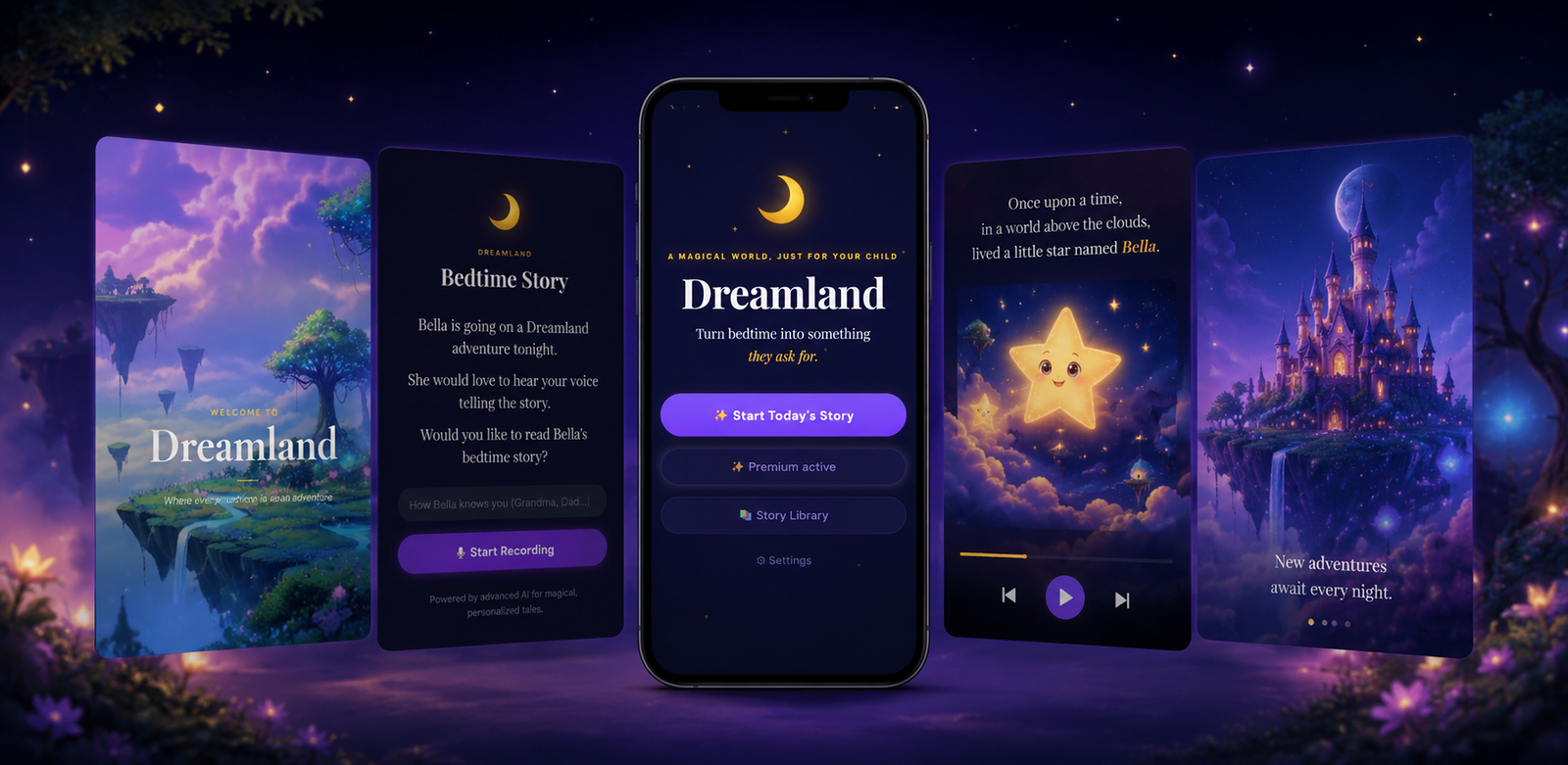
I'm going to skip the polished version of this story, because the polished version isn't true. The true version is that Dreamland is now live. You can download it on the App Store and on Google Play tonight. And for a lot of the last year, I genuinely didn't think I'd get to write this post.
I'm a mum of three. I work full-time. And somewhere in between school runs, deadlines, and the nightly negotiation over one more story, I decided, for reasons I still can't fully explain, that I was going to build an app.
It started with the kids, not with a business plan
There was no market research. No pitch deck. Dreamland started because I'd genuinely run out of stories. Years of making them up on the spot, every single night, and one evening I just had nothing left. My kids were fighting. Not about the story itself, but about whose turn it was to choose where we went that night, and who got to be in it. Three kids, one bedtime story, and constant negotiation over whose character got the spotlight.
The door came from something I already did every night, long before there was an app. I'd tell them to close their eyes and picture a door. That alone was usually enough to calm three wound-up kids down and get them still. So when Dreamland needed a way to begin every story, there was only ever one answer. That door isn't a design choice. It's the exact thing I say out loud at bedtime, every night, that actually works.
There are no videos in Dreamland, and that's deliberate. The entire point was to calm them down and avoid handing them another screen to stare at. I wanted them imagining the story, not watching it happen. The images came later, and only because they asked for them. They wanted to see if what they'd pictured in their heads matched what came up on the screen. That's the whole feature history really. Closing your eyes, and then checking your imagination against the picture.
So it truly did start cuddled up in bed with my kids, not at a desk. These characters were theirs as much as mine. If I forgot a detail, they corrected me instantly.
So the idea wasn't "let's build a children's app." It was "what if I didn't have to be the only one who could tell this story right." My kids picked the characters. They named the worlds. They told me, very seriously, which foods a tiny taco adventurer would and wouldn't eat. I'm genuinely proud that they were part of building this from the very beginning, not as an audience I designed for, but as actual collaborators at the kitchen table.
I wasn't trying to launch a product. I was trying to hold onto something that already belonged to my kids, and it turned into this instead.
The part nobody puts in the launch post
I want to be honest about the middle of this, because the middle is where most of these projects quietly die. There were entire weeks where I built after everyone was asleep and second-guessed everything I'd made by the next morning. There were technical problems I didn't have the language for yet. There were nights I sat looking at a broken build at 11pm, exhausted from a full day of actual work, wondering if I was doing this for my children or just proving something to myself.
I almost gave up more than once. Not dramatically, just quietly, the way you give up on things when nobody's watching and there's no deadline forcing your hand. It would have been easy to let it become "that thing I was building" instead of the thing that actually exists now.
What kept me going, in the end, wasn't a business goal. It was smaller and more human than that.
How it actually got built
I'm not a trained developer. I don't say that as false modesty. I genuinely built the first working version of Dreamland by describing what I wanted and iterating on it, over and over, using AI tools to write and fix the code alongside me. People have started calling this "vibe coding," and it's a fair description: less blueprint, more conversation, a lot of "okay, that's not quite it, try again."
I later moved parts of the build over to more traditional tooling as things got more complex. Payments, app store submissions, the parts that needed to be bulletproof rather than just functional. But the very first proof that this idea could exist outside my head came from sitting down with no coding background and just describing what I wanted until it appeared. If that's the only thing this post inspires someone else to try, that's enough for me.
It's the same instinct behind most things that actually get finished. I'm just a full-time working mum with a laptop, no engineering background, and no team. The honest truth is that most of what I learned about shipping something real came from starting badly and improving it in public, rather than waiting until I felt ready.
And I should say, the reason this ever became an app at all, rather than staying a story I told my kids at bedtime, is my husband. I'd been telling these same stories for years without it occurring to me they could be anything more. He was the one who kept saying, "you should turn this into something," over and over, long before I took it seriously. I brushed it off for months. He didn't let it drop. So this whole thing exists, in a very real way, because he saw something in it before I did.
The messages that made it worth it
Before Dreamland was ever public, a handful of fellow mums helped me beta test it. Just people I knew, using it at real bedtimes with their own kids, telling me honestly what worked and what didn't. One of those messages has stuck with me since.
"We've been using Dreamland for a week now and we're all obsessed. My son loves choosing his characters, and it's quickly become such a lovely part of our bedtime routine."
Georgia Ellyn Nichol, one of my beta testers
I read that on a day I genuinely needed it. It's one thing to believe in something you've built at your kitchen table. It's a completely different thing to hear that it made someone else's evenings calmer, someone with her own children, her own exhausting version of 7:30pm, and this was still before anyone outside our small testing group had even seen it.
Then there was launch day itself. I shared Dreamland in my own group chat of mum friends, the people who'd watched me disappear into "the app thing" for months without fully knowing what it was. One of them passed it straight on to another friend of hers, who tried it that same afternoon for her son's nap. Not because she had to, not to be kind, just because it worked. Hearing that, on the day it actually went live, did something that no amount of my own belief in the project could do.
I shared Dreamland with the group, half-nervous, and one of the mums immediately passed it on to a friend of hers. That friend tried it that same afternoon, recorded her own voice into the story, and came back a little later to say her son loved it during his day nap.
Feedback from actual families, and the quiet support of friends who show up for you without needing to understand the whole thing, is what carries a project through the parts that don't make it into the launch post.
What "live" actually means
Dreamland is now available to download, free to start, on both iOS and Android. My kids' characters, the ones they invented, argued about, and refined over years of actual bedtimes, are now something other families' children can meet too. That still doesn't feel entirely real to type.
If you're a parent reading this at the tail end of a long day, thinking about some version of your own bedtime routine, I hope Dreamland gives your family something like what it gave mine. And if you're sitting on an idea of your own, half-built or not built at all, wondering if you're allowed to actually try it without a technical co-founder or a proper plan: you are. I promise you are. Start badly. Describe what you want. Fix it tomorrow. That's genuinely how this happened.
If you want to get started, I'd genuinely recommend trying Replit, it's what I built the first version of Dreamland on. That link also gets you some free credits to get going.
Try it tonight, on your device
Dreamland is live now, free to start, with your child's own character ready for their first story.