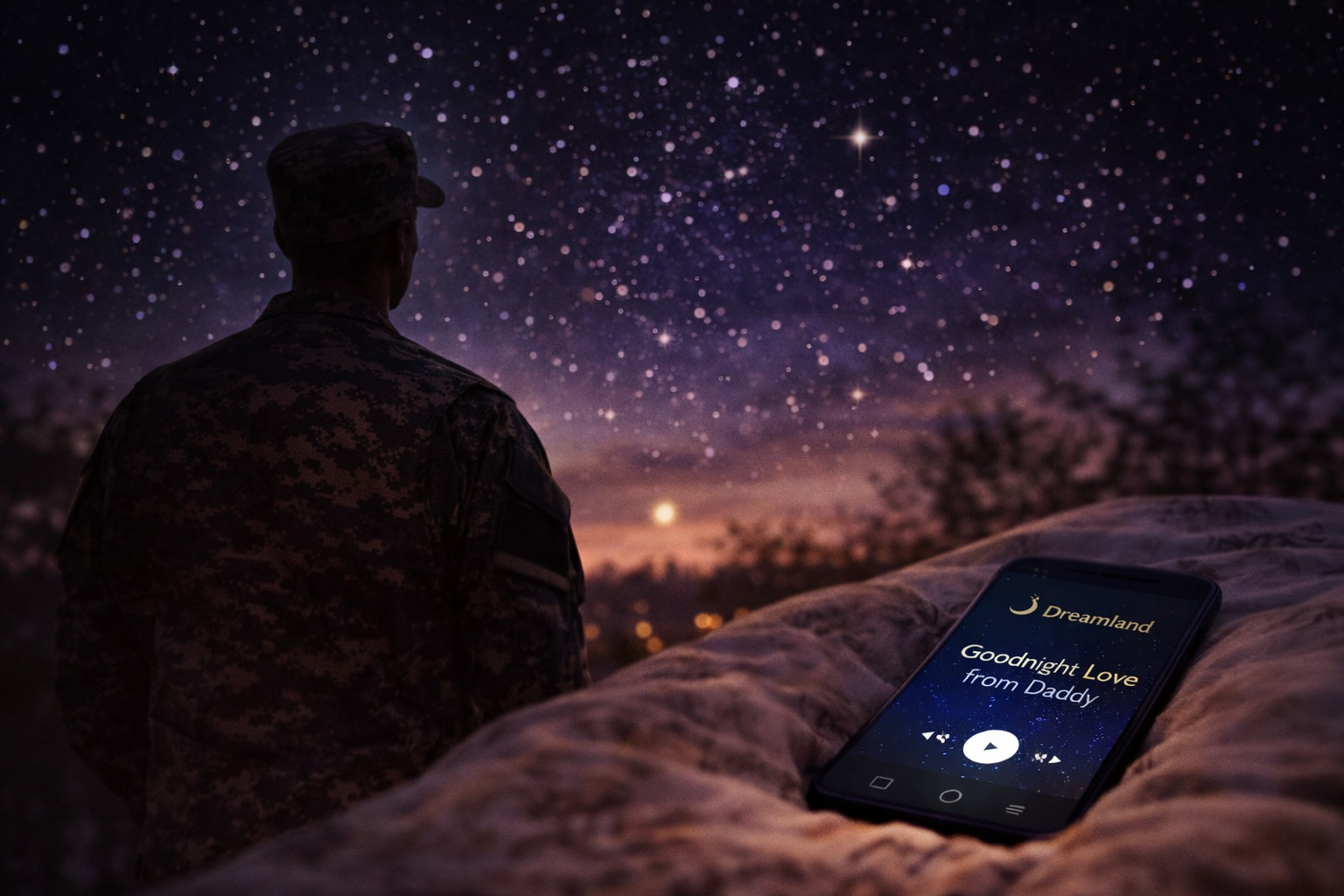
Military families don't need to be told that deployment is hard. They know. They've prepared. They've had the conversations, made the plans, said the difficult goodbyes.
What nobody quite prepares you for is 7pm.
That's the hour when small children become their most irrational, their most emotional, their most in need of the person who isn't there. The parent at home — holding everything together, managing the school run and the laundry and the loneliness — reaches the end of the day when they most need help, and there is no one to give it. And the parent thousands of miles away, on a base in a different time zone, carrying a completely different kind of weight, wants nothing more than to be the one reading the bedtime story.
Bedtime is where the distance is hardest to ignore.
"Children need to know the parent who's away is still their parent. Not just in concept — but present, familiar, woven into daily life. Bedtime is how you do that."
Why deployment hits hardest at bedtime
Young children process the world through routine. Their sense of safety is built not from grand gestures but from the reliable repetition of small things — the same cup, the same story, the same voice saying goodnight.
When a parent is deployed, one of those voices disappears. The child still looks for it, still expects it. In the first weeks, they may ask for the absent parent at bedtime more than at any other time of day. That's not coincidence. It's the moment their nervous system is looking for all its safety signals — and finding one missing.
For the parent at home, this moment is the hardest of the day. They are managing their own grief, their own anxiety about a partner deployed in difficult circumstances, while simultaneously trying to be enough for a child who is too young to understand why things have changed. Asking for help feels impossible. There often isn't anyone to ask.
The logistics problem with staying connected
Video calls are the default solution. They help. But they come with a problem that military families know well: time zones, unreliable connections, and schedules that don't answer to anyone's emotional needs.
The video call problem
- Time zones rarely align with bedtime
- Connections drop at the worst moments
- Young children don't know what to say
- Call has to be planned and coordinated
- Pressure on both sides to "perform" connection
- One bad call creates anxiety for days
What actually works
- Async connection — recorded when possible
- No signal required at the moment it plays
- Child has something to look forward to
- No scheduling required
- Feels natural, not performative
- Consistent regardless of operational tempo
A deployed parent in the Middle East is not at bedtime when their child in the UK is going to sleep. They might be starting a shift, coming off one, or in a location where calling isn't possible at all. Asking them to be available at a fixed time, every evening, is asking the impossible. And when the call doesn't happen — when the child expected it and it wasn't there — it's not just disappointing. For a young child, it can feel like another loss.
What children actually need from the absent parent
Research on children with deployed parents points to the same things consistently: predictability, familiar sensory cues, and reassurance that the absent parent is still thinking about them. They don't need long conversations. They don't need detailed explanations of where the parent is or why. They need to feel, in their body, that the person is still real and still close.
A voice does this better than almost anything else. Hearing a familiar voice — not seeing a face on a screen, not reading a message — triggers a physical comfort response in young children. It's the same reason a child can be settled by hearing a parent's voice from another room. The voice itself is the signal: you are safe, I am here, you can rest.
A recorded bedtime story in a deployed parent's voice is not a workaround.
It's 7:30pm in Portsmouth. Jess has been managing solo for eleven weeks. Her daughter, age 5, asks every night if Daddy will call. Sometimes he can. Often he can't — and the explaining is the hardest part. But tonight, the daughter climbs into bed, opens the app, and says "can I hear Daddy's story?" The voice that comes out is her father's, recorded on a quiet afternoon two weeks ago. He narrates a story about a brave girl who adventures through a magical world. She falls asleep before it's over.
The gift of asynchronous connection
The word "asynchronous" sounds clinical. What it means, practically, is this: the person who loves your child can record a bedtime story when it's possible for them — in a moment of quiet, in a break between duties, on a weekend afternoon — and that recording is waiting for your child every night they need it.
No coordination required. No hoping the signal holds. No child falling asleep at the screen waiting for a call that's running late. Just a voice, always there, always ready.
For the deployed parent, this also changes something important: it moves contribution from reactive (responding when called) to proactive (creating something that keeps giving). A parent who records three or four stories during a period of relative calm has given their child a week or more of nightly connection. They did something real, when they had the capacity to do it, that matters long after the moment passed.
How Dreamland makes this work
Dreamland was built with exactly this kind of family in mind. The app's Family Narrator feature lets any parent — deployed or otherwise — record their voice once. Dreamland then uses that voice to narrate personalised bedtime stories, built around the child's own characters, names, and the worlds they've already explored inside the app.
From the child's perspective: they open the app, choose their story, and hear their parent's voice reading just to them. They don't know it was recorded two weeks ago in a base canteen. They know it sounds like Mum. They know it's their story. That's all that matters.
The deployed parent records when they can
Five minutes. Any time, anywhere. No scheduled call, no coordination — just a voice recording on a quiet morning or between duties. It uploads whenever there's a connection.
Dreamland generates a new story, personalised to your child
The child's name, their custom character, the world they've been building inside the app. Each story is fresh — so it never feels like replaying a recording.
Bedtime. Child hears their parent's voice, every night.
No call to coordinate. No timezone to navigate. The parent at home gets a moment to breathe. The child gets what they need: the absent parent, present.
For the parent at home: you are allowed to need a break
Something that military families don't talk about enough: the parent managing solo during deployment carries an enormous load, and they often carry it in silence. Asking for help can feel disloyal to the weight of what their partner is carrying. Taking a break can feel selfish when everything depends on them holding it together.
Ten minutes to sit down while a story plays is not selfish. It is, in fact, exactly what your child needs you to do — so that you can show up again tomorrow. The most useful thing you can do for a child during a parent's deployment is not to be superhuman. It is to be sustainable.
A bedtime story that runs itself is not you abandoning the routine. It's you having built a routine that works — one that keeps your child connected to the parent who's away, while giving you back a small piece of yourself at the end of the hardest hour of the day.
You recorded it two weeks ago in a canteen. Your daughter hears your voice tonight. That's it. That's the whole thing.
What this looks like after deployment
One thing worth saying: Dreamland's Family Narrator feature doesn't only matter during deployment. Many military families find that the bedtime routine they built — the voice, the stories, the child's own characters and world — becomes something they continue long after the parent comes home. The child has grown to love their story world. The routine works. Some families find the deployed parent continuing to record stories even after reunion, simply because the children ask for it.
A lot of families keep using it after the parent comes home. By then it's just part of bedtime.
Be there at bedtime — even from thousands of miles away
Dreamland lets deployed parents record their voice once. Your child hears you read their personalised story, every night — no call to coordinate, no timezone to fight.
Join the waitlist