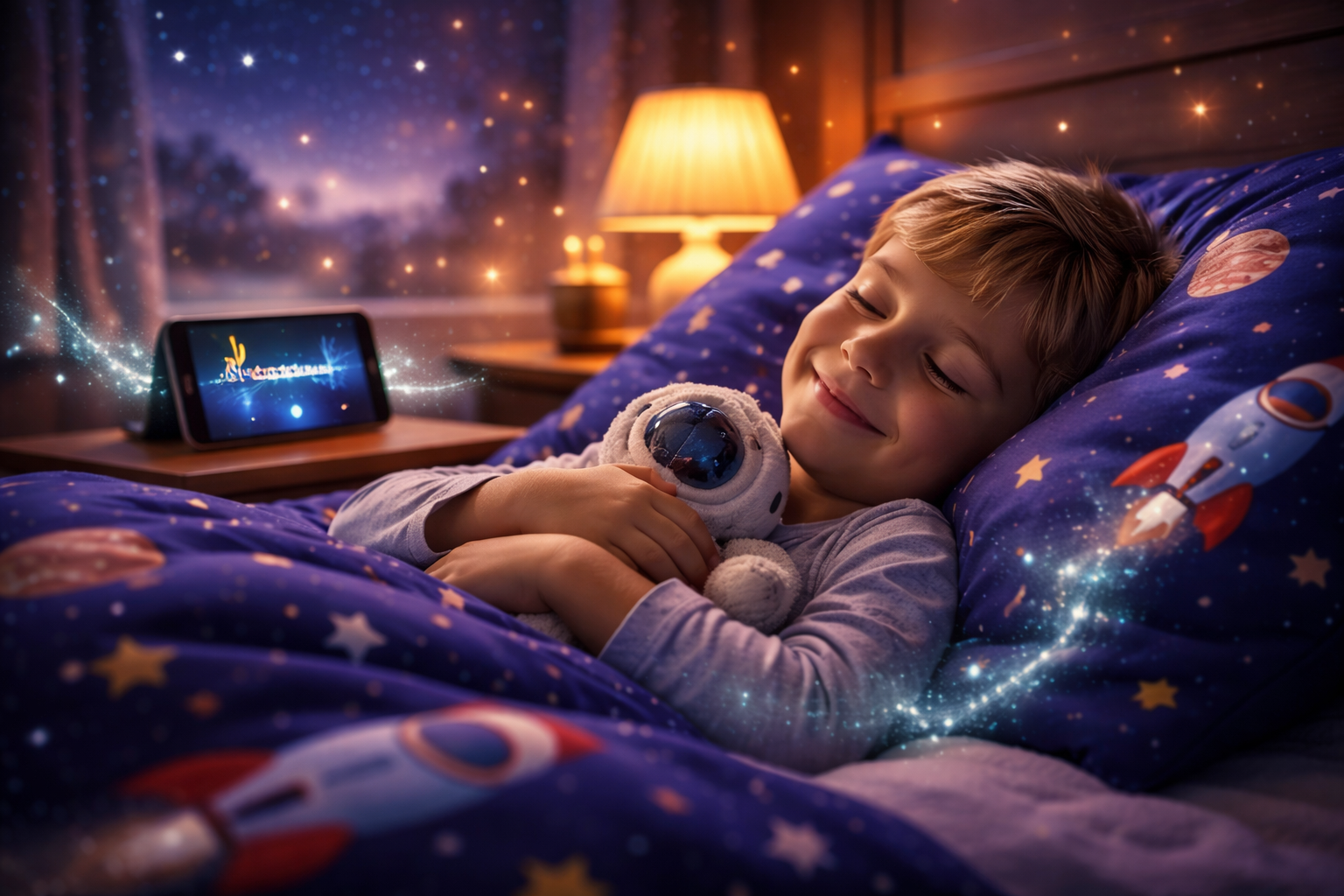
Open the App Store and search for bedtime story apps. You'll find dozens. Most have four-star ratings. Most claim to be personalised. Most look, at first glance, roughly the same.
But spend a week actually using them with a child — a real child, at a real 7:30pm, after a real day — and the differences become obvious fast. Some apps make bedtime calmer. Some inadvertently make it harder. A few become something a child genuinely looks forward to every night.
What separates them isn't price, or library size, or how polished the onboarding looks. It comes down to a handful of features that are either built around how children actually sleep — or aren't.
Here's what those features are, why they matter, and what to look for when you're evaluating an app for your family.
Children's brains are looking for safety signals
Young children don't fall asleep because they're tired. They fall asleep when their nervous system registers that it is safe to do so. Consistent bedtime routines — the same sequence of familiar events — are how children's brains receive that signal. A story in a familiar voice, at the same time, in the same way, is not just comfort. It is sleep architecture. Apps that understand this build their features accordingly. Apps that don't tend to add stimulation where there should be calm.
A peer-reviewed study of 10,085 children across 14 countries, published in the journal Sleep (Mindell et al., American Academy of Sleep Medicine), found that children with a nightly bedtime routine slept over an hour longer per night than those with no routine — and that the more consistently the routine was applied, the stronger the benefit.
Feature 1: Personalisation that goes beyond a name
The child as the hero
The simplest personalisation is dropping a child's name into a pre-written story. It's better than nothing, but children see through it quickly. By the second or third night, they notice that "Emma" is in the story but Emma isn't really doing anything different to what any character would do.
Deeper personalisation means the child has built a character — their appearance, their name, their traits — and that character carries across stories over time. It means the worlds they explore, the choices they make, the adventures they have are genuinely theirs. That's the level that keeps a child coming back.
Research on what's called the "self-reference effect" consistently shows that children retain and engage with information better when it relates directly to themselves. Studies published in Frontiers in Psychology found the effect present in children as young as three. A 2024 meta-analysis in the British Journal of Educational Psychology — drawing on 1,082 students across 13 studies — confirmed that self-referential encoding meaningfully improves learning outcomes. Separate research from the University of Dundee confirmed that self-referencing increases children's engagement in literacy tasks and improves spelling and word retention. The child who is the hero is not just entertained — they are building narrative identity, which is a foundational skill for both literacy and emotional development.
Custom character creation that persists across stories. Choices that affect the narrative. A world or setting the child builds over time, not just a one-off personalised story.
Feature 2: A familiar voice
Narration as a safety signal
A child's nervous system responds to familiar voices at a neurological level. Hearing a parent, grandparent, or caregiver speak activates the same comfort response as physical proximity. This is why a child can settle in a darkened room simply by hearing a parent's voice from another room — the voice itself is the signal that says "you are safe."
Most bedtime story apps use professional voice actors or AI-generated narration. This is fine — a warm, well-paced professional narration is significantly better than nothing. But it doesn't carry the same signal weight as a voice the child already knows and loves.
A growing number of apps now offer the ability to upload a family member's voice — a parent, a grandparent, anyone — to narrate the stories. For families where a parent travels frequently, or where grandparents live in another country, this feature changes what a bedtime app can do entirely. It's no longer a substitute for a person. It's a way for that person to actually be there.
High-quality professional narration as a baseline. Family voice upload or voice cloning as a premium option — particularly valuable for families with distance between generations or a traveling or deployed parent.
Feature 3: Content that calms rather than stimulates
Designed for sleep, not just entertainment
Some bedtime story apps are genuinely designed to support sleep. Others are entertainment apps that happen to feature bedtime as a theme. The difference shows in the details.
Apps designed for sleep have consistent pacing — stories that slow down rather than speed up, narration that is warm and measured rather than energetic, visual elements (if any) that are gentle rather than bright. They don't use reward sounds, achievement notifications, or interactive elements that require the child to tap rapidly and stay cognitively active.
Apps designed primarily for engagement — even educational engagement — often have the opposite qualities. They are built to keep a child's attention during the day, and that design doesn't switch off at bedtime.
Calm, measured narration. No achievement sounds or pop-up rewards. Minimal or warm-toned visuals. Stories that arc toward a resolution and natural ending rather than cliffhangers. A "sleep mode" or audio-only option is a strong signal the app is genuinely designed for bedtime.
Interactive story apps — where children tap to make choices, unlock branches, collect rewards — are excellent tools for daytime reading engagement. They are generally a poor fit for the 30 minutes before sleep. The cognitive engagement required to make choices keeps the brain active in exactly the way bedtime routines are meant to wind down. Save the interactive stories for afternoon; use calmer, narrative-led content at night.
Feature 4: Content that doesn't run out
Fresh stories vs fixed libraries
A library of 500 stories sounds like it will last forever. In practice, a child who uses the app every night will cycle through their favourites within weeks and exhaust genuinely new content within months. At that point, the app becomes an obstacle to bedtime rather than a support — the child is bored with the options, the parent is trying to find something they haven't heard, and the routine that was working is now causing friction.
There are two solutions to this. The first is regular content additions — apps that publish new stories weekly or monthly. This keeps the library feeling fresh but still creates an eventual ceiling. The second is AI-generated content, where stories are created fresh each time based on the child's character, current interests, and the specific world they're exploring.
AI-generated stories have an important advantage for bedtime specifically: because each story is new, there's no "I've heard this one" resistance. The child can have a different adventure every single night, in the same familiar world, with the same character they've grown to love. The routine stays consistent even as the content stays fresh.
Either a large library with documented weekly additions, or AI story generation that creates unique content each session. Ask specifically: what happens after my child has heard all the stories? A good app has a clear answer.
Feature 5: Privacy that parents can trust
Your child's data is not a product
Bedtime story apps sit in an unusually sensitive position: they are used in bedrooms, by young children, often with audio of the child or their family members involved. The privacy standards that apply here should be higher than for most apps — and many parents don't think to check until something prompts them to.
The questions worth asking: Is the app COPPA or GDPR compliant? Are voice recordings stored on external servers, or processed locally on the device? Is the app ad-supported, and if so, who is targeting your child? If AI is used to generate stories, is your child's name and character data being used to train models?
Good apps make this information straightforward to find. If the privacy policy is buried, vague, or uses language that suggests data may be "shared with partners," that is worth noting before you hand it to your child at bedtime.
Clear COPPA/GDPR compliance statements. Explicit confirmation that voice data is not stored externally. No advertising within the app. A privacy policy written in plain language, not legalese.
The simplest test of all
All of the above criteria matter. But there is a simpler test that tells you more than any feature list:
Does your child ask for it again tomorrow? Not because you told them to — because they wanted to find out what happens next.
An app that makes a child want to go to bed is an app that is working. That's a high bar, and it's the only one that really counts. The features above are the mechanisms by which good apps clear it — personalisation that makes the story feel like theirs, a voice that feels like safety, content paced for calm, and stories that never run dry.
When it works, the child asks to go to bed. That's the sign.
A quick reference: what to look for
- 🧒 Child-as-hero personalisation — not just a name swap, but genuine character ownership across stories
- 🎙️ Warm, high-quality narration — professional voice actor as baseline, family voice upload as a bonus
- 🌙 Sleep-first design — calm pacing, no reward sounds, minimal visual stimulation
- ♾️ Content that doesn't run out — either AI-generated fresh stories or a library with regular additions
- 🔒 Strong privacy — COPPA/GDPR compliant, no voice data stored externally, no ads targeting children
- 📵 Offline capability — stories should work on a plane, in a cottage, anywhere without reliable wifi
- 💷 Transparent pricing — free trial that lets you genuinely evaluate it, clear subscription terms
Dreamland is built around these principles
AI-generated stories personalised to your child, in a family member's voice, in a world they've made their own. See what that feels like in practice.
Join the waitlist