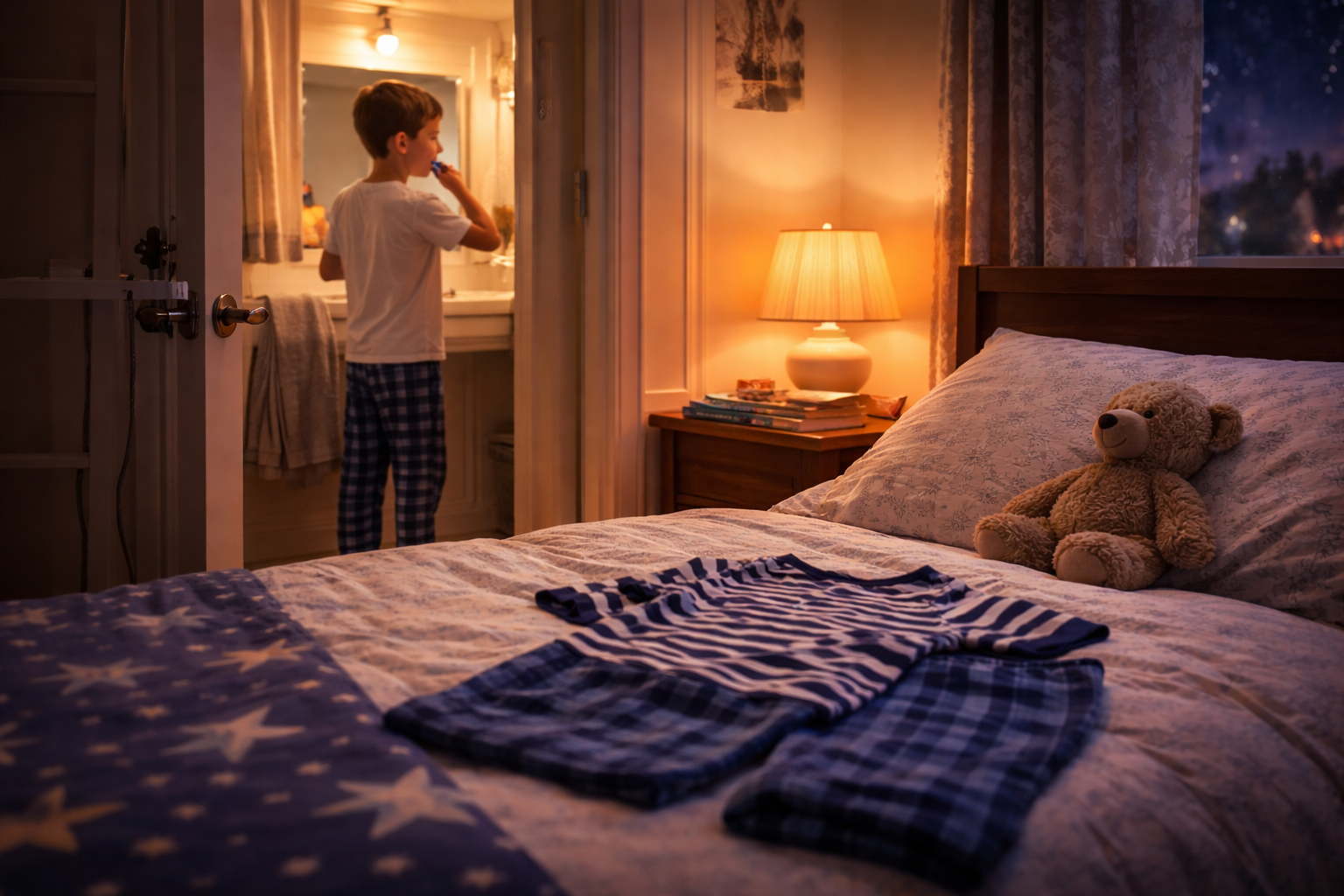
Most parents discover the power of a bedtime routine by accident — usually after a run of chaotic evenings that somehow produce chaotic nights, followed by one quiet, predictable bedtime that ends with a child asleep in twenty minutes and a parent sitting down in actual silence.
That's not coincidence. It's biology.
A consistent bedtime routine works because of how young children's brains are wired — not because of any particular activity within it, but because of the repetition itself. The same sequence of events, night after night, becomes a signal. And that signal, once learned, does exactly that: it begins the process of sleep before the child is even in bed.
Understanding why this works makes it far easier to build and protect a routine — and to know what actually belongs in it.
Consistent routines produce measurably better sleep
A landmark study published in the journal Sleep by Dr Jodi Mindell at Saint Joseph's University followed 10,085 children across 14 countries and found that children with a nightly bedtime routine slept over an hour longer per night than those with no routine. They fell asleep faster, woke less during the night, and had fewer sleep problems overall.
Critically, the study found a dose-dependent relationship: the more nights per week the routine was applied consistently, the stronger the sleep benefit. Even moving from three nights to five nights per week produced measurable improvement. The researchers concluded that instituting a bedtime routine is one of the simplest, most universally effective interventions available to parents — regardless of culture, country, or income level.
A separate study published in Frontiers in Sleep (2023) found that toddlers with consistent bedtime routines from as early as 12 months showed fewer social-emotional problems at 24 months — suggesting the benefits extend well beyond sleep itself.
What a routine actually does to a child's brain
Sleep doesn't start when a child closes their eyes. It starts significantly earlier — in the gradual physical and neurological wind-down that good routines are designed to trigger. By the time a child who has a consistent bedtime routine gets into bed, their brain has already begun preparing for sleep. Melatonin production is rising. Heart rate is slowing. Cortisol — the alertness hormone — is falling.
The routine is doing that. Not the bed. Not the darkness. The familiar sequence of events that the brain has learned, through repetition, to associate with what comes next.
This is why the order matters as much as the activities. It's not enough to do the same things every night — they need to happen in roughly the same sequence. Bath, then pyjamas, then teeth, then story. Or whatever order works for your family. The brain is learning a pattern, and patterns require consistency to stick.
The routine isn't the bath or the teeth or the story. It's what your child's brain does with the fact that those things happen in the same order every night.
The signals your child's brain is listening for
Young children don't experience time the way adults do. They can't look at a clock and decide to feel sleepy. What they can do is read their environment for cues that tell them what is about to happen. A good bedtime routine is essentially a sequence of those cues — each one landing quietly in the nervous system as a step closer to rest.
Warm water and touch
A bath raises then lowers body temperature, which mimics the natural temperature drop that accompanies sleep onset. It also provides physical comfort and sensory calm.
Dimmer light
Lower light levels signal the brain to increase melatonin production. Warm, soft lighting in the hour before bed measurably accelerates the transition to sleepiness.
Familiar clothing
The physical act of changing into pyjamas is a surprisingly powerful cue. It signals a transition — from the daytime self to the nighttime one — that children's brains learn to associate with sleep.
A calm, familiar voice
Hearing a warm, unhurried voice tells a child's nervous system that the environment is safe. This is one of the oldest and most reliable sleep cues available — and it works whether the voice is in the room or playing gently through a speaker.
Story
A story channels a child's imagination into a contained, directed experience rather than the free-floating anxiety that can emerge when small minds are left to wander in the dark. It keeps the mind occupied without keeping the body awake.
Repetition itself
Perhaps the most powerful signal of all. A routine that happens the same way, night after night, becomes self-reinforcing. Eventually the child stops fighting it.
What the research says about children and audio at bedtime
Story has been part of bedtime for as long as there have been children and adults to tell them. What's interesting is what specifically makes the audio experience of a story so effective at this particular moment of the day.
When a child listens to a story — rather than watching something — their brain is engaged in a very specific kind of active rest. They are constructing images, following a narrative, inhabiting a world. But they are doing it with their body still. Their eyes can be closed. Their muscles can relax. The story gives the mind something to hold onto while the body lets go.
Audio without an active visual component is particularly well suited to this. When a child is simply listening — to a voice telling a story, to familiar sounds, to something calm and unhurried — the nervous system can settle in a way that active visual engagement doesn't allow. The imagination does the work, and imagination, unlike attention directed at a screen, is inherently soothing at the right pace.
A calm narrated story, listened to in a darkened room, is doing several things at once: giving the mind a gentle focus, the body permission to be still, and the nervous system the signal that nothing requires a response. Most children are asleep before the story finishes.
The benefits that go beyond sleep
Better sleep is the obvious outcome of a consistent bedtime routine. But research and parental experience consistently point to benefits that accumulate over time and show up in unexpected places.
-
🧠
Emotional regulation during the day Children who sleep well are significantly better at managing frustration, disappointment, and social difficulty. The emotional resilience built during rest shows up in behaviour long before bedtime.
-
🔒
A stronger sense of security Predictable routines are one of the primary ways young children develop a felt sense of safety in the world. A child who knows what happens next — reliably, night after night — is a child who trusts their environment.
-
📚
Language and literacy development A nightly story is a nightly vocabulary lesson. Children who are regularly read to — or who listen to narrated stories — develop richer language, better comprehension, and stronger reading skills over time.
-
🤝
Stronger parent-child connection The bedtime routine is one of the few moments in a busy day that belongs entirely to the relationship between parent and child. Repeated consistently, it becomes one of the anchors of that relationship — especially during periods of stress or change.
-
😌
Calmer evenings for the whole family A routine that works doesn't just benefit the child. It changes the texture of the entire evening. When bedtime is predictable and low-conflict, the hour before it is different too — less braced, less negotiated, less exhausting.
What a good routine actually looks like
There's no single right bedtime routine. What works depends on your child's age, temperament, and your family's rhythm. But most effective routines share the same underlying structure: a gradual shift from activity to stillness, over a defined period of time, ending in a contained and calming experience just before sleep.
Here's what that might look like in practice for a child aged three to seven:
Begin the wind-down
Lower the energy of whatever is happening. Calm play, a quiet activity, or simply turning down the pace of the evening. This is the transition out of the day — it doesn't need to be structured, just slower.
Bath or wash
Warm water and physical care. This is as much about sensory comfort and the signal of transition as it is about cleanliness. Keep it calm and unhurried.
Pyjamas and teeth
The physical markers of night. Brief, practical, consistent. Their placement in the sequence matters — they signal that the routine is progressing toward sleep.
Into bed
The environment matters. Dim light, a comfortable temperature, familiar surroundings. This is the point at which the child's body should already be beginning to slow — if the earlier steps have done their job.
Story
The last active experience before sleep. A calm, narrated story gives the imagination something to inhabit while the body completes its transition. It should settle, not stimulate.
Goodnight
A consistent, brief, warm goodbye. The same words, the same gesture if you have one. This is the final signal. The routine is complete. Sleep is next.
The hardest part: protecting the routine
Building a routine is easier than keeping it. Life disrupts things — late dinners, social events, travel, illness, exhausted parents who skip a step and find the whole thing unravelling. This is normal. The research is reassuring here too: it's the overall consistency that matters, not the perfection of any single night. A routine that happens five nights out of seven produces most of the benefit of one that happens every night.
What matters most when the routine is disrupted is returning to it quickly. Not making a production of the disruption, not apologising for it — simply picking it back up the following night as if it never happened. Children are resilient and adaptable. The routine will reassert itself faster than you expect.
The value of a bedtime routine isn't in any individual element — it's in the pattern. A bath, pyjamas, teeth, story, goodnight: none of those things is magic on its own. But repeated together, in the same order, at roughly the same time, they become something the child's brain can rely on. And that tends to mean an easier night.
Where Dreamland fits in
Dreamland is designed to live at the story part of the routine — the moment just before sleep when the imagination is invited somewhere calm and familiar. Each night, your child's own character sets off into one of their favourite worlds: through the Stardust Mountains, along the shores of Bubble Ocean, into the cosy warmth of Dreamy Mushroom Village.
The story is different every night — generated fresh so it never feels like a repetition — but the ritual of it is the same. Same worlds. Same character. Same voice, whether that's a professional narrator or a family member who recorded themselves on a Sunday afternoon.
The story ends. Your child already knows what comes next.
Make story the best part of bedtime
Dreamland generates a fresh, personalised bedtime story for your child every night — in their world, with their character, in the voice you choose.
Join the waitlist