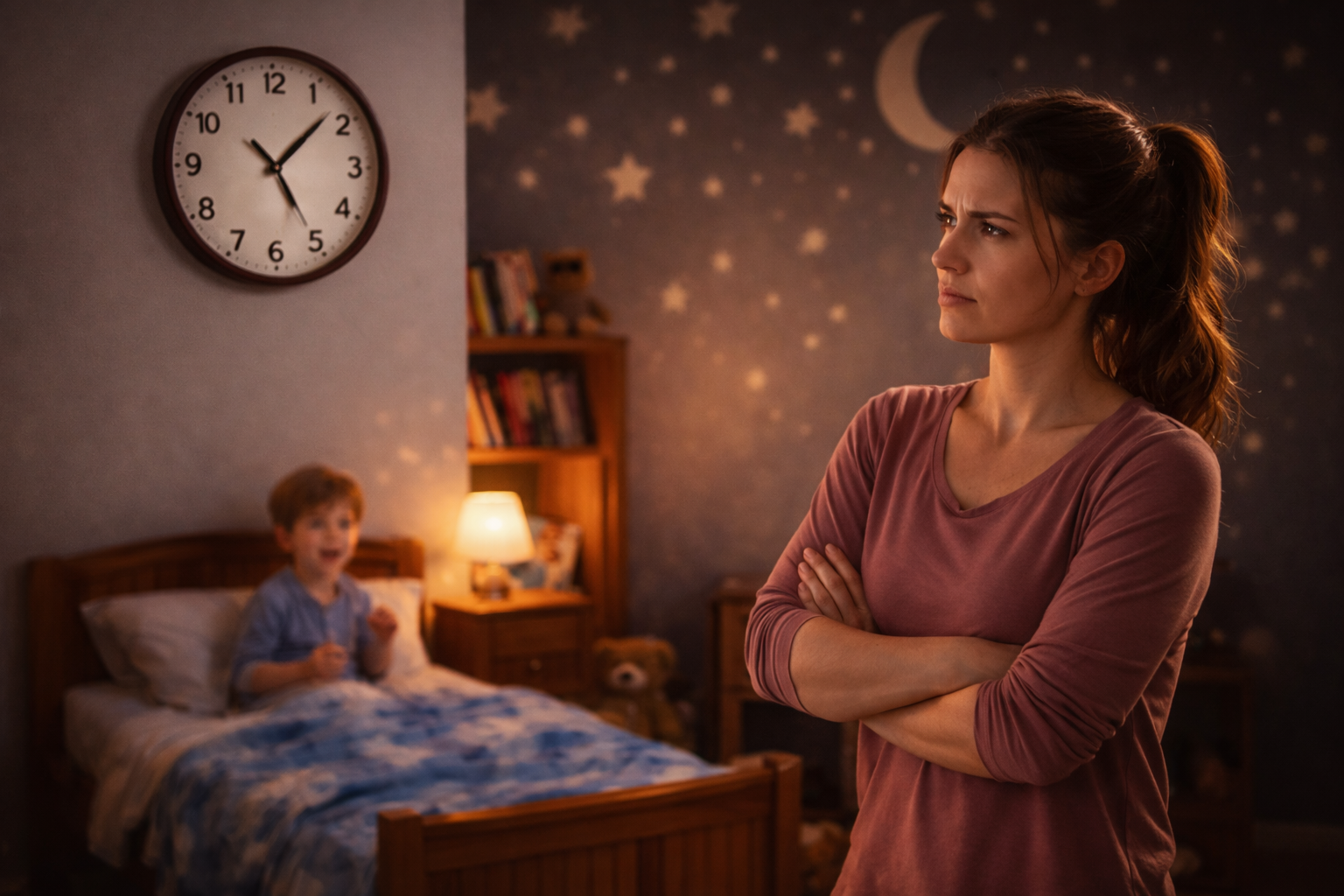
Those "one more question" moments aren't stalling. Science says they might be the most important conversation of your child's day.
That moment when you're almost at the door, and they start talking.
It happens in almost every household. You've done the bath, the pyjamas, the teeth brushing. You tuck them in, turn off the light. And that's when it starts. The questions. The worries. The story about something that happened at school two weeks ago. The sudden need to discuss whether fish have feelings.
It feels like stalling. But it isn't. And understanding why children become emotionally open at bedtime might change the way you show up for one of the most important rituals of your parenting day.
Children's days are relentless. School demands performance: answering questions correctly, navigating social dynamics, managing sensory input, suppressing impulses. Even a perfectly ordinary Tuesday is, for a young child, an enormous amount to process.
By the time bedtime arrives, something shifts. The demands of the day have lifted. There's no classroom to perform in, no sibling to compete with, no task demanding their attention. What's left is stillness, and a parent sitting beside them in the dark.
This isn't a coincidence. It's the first genuinely low-pressure moment many children experience all day.
Child psychology research consistently shows that children, just like adults, are more likely to open up in relaxed, distraction-free environments. Bedtime and car rides are among the settings most commonly associated with spontaneous emotional disclosure. When the environment slows down, the inner world can finally be heard.
It's tempting to think of this as the brain "switching modes," but that's not quite what's happening. It's not that children suddenly become more emotional at night. It's that the conditions finally allow emotions to be accessed and expressed.
During the day, high stimulation, performance expectations, and competing demands act as emotional gatekeepers. Worries get buried under busyness. Feelings that haven't been named don't surface — not because they don't exist, but because there's no space for them.
At bedtime, several things converge:
Screens are off. The house is quieter. The nervous system begins to downregulate.
There's nowhere to be. No transitions happening. Time feels expandable.
A parent's undivided attention, rare and precious, is finally available.
As the body prepares for sleep, physiological arousal drops. The guard comes down.
Together, these conditions create something rare in a child's day: emotional safety with nowhere to be. The thoughts that were buried surface. The questions that felt too small, or too big, to ask finally find a voice.
Sleep doesn't just restore the body. It actively processes the emotional residue of the day, and the transition into it is when that processing begins.
Sleep researchers, including Matthew Walker in Why We Sleep, have documented how sleep supports emotional regulation and memory consolidation. The period leading into sleep is not neutral waiting time. It's active emotional processing — which means the conversations that happen at the edge of sleep may carry more weight than we realise.
For this bedtime openness to exist, something else has to be in place first: predictability.
Children don't open up in uncertain environments. They open up when they feel safe, and safety, for a young child, is built largely through routine. When bedtime follows a consistent pattern, the child's nervous system recognises what's coming. The routine itself becomes a signal: this is a safe time.
Research by Mindell et al. found a dose-dependent relationship between consistent bedtime routines and improved sleep quality, better emotional regulation, and fewer behavioural issues in young children.
Mindell et al., Sleep, 2015Kelly et al. found that children with irregular or late bedtimes showed significantly more emotional and behavioural difficulties than peers with consistent sleep schedules.
Kelly et al., Pediatrics, 2013The takeaway isn't just that routine helps children sleep. It's that routine creates the conditions where emotional expression becomes possible. Consistency signals safety. Safety opens doors.
Here's what's actually happening when your child asks one more question at 8:47pm, when the light is off and you're already halfway out the door:
Something that happened during the day — a comment from a friend, a moment of confusion, a worry they couldn't name — has been waiting. Not consciously. Children don't typically know they're carrying something. But as the day's demands fall away and the body slows, whatever was stored comes forward.
The child isn't engineering a delay. They're surfacing. And if the parent dismisses it with "go to sleep" or "we'll talk tomorrow," they learn — slowly and without knowing it — that this window isn't available to them.
Most parents who rush the bedtime routine aren't doing so out of indifference. They're exhausted. The evening has been long. There are dishes, a work email, five minutes of quiet before their own bedtime. The instinct to say "tomorrow" is completely understandable.
But consider what can be revealed in those unguarded two minutes:
The child who says "but I need to tell you something" at lights-out isn't always stalling. Sometimes they genuinely didn't know they needed to say it until right now, when the quiet finally made space for it.
Bedtime is an emotional insight window. The conversations that happen in those final minutes often reveal more about a child's inner life than an entire week of daytime check-ins.
When parents regularly engage with their children's bedtime openings — staying a few minutes longer, asking genuine questions, listening without rushing — something significant builds over time.
The American Academy of Pediatrics' guidance on emotional development consistently emphasises the role of responsive, secure attachment in children's long-term wellbeing. When a child learns that their emotional expressions are met with genuine attention, they develop:
Children who feel heard become better at identifying and managing their own emotional states.
The habit of putting feelings into words, practised nightly, builds lasting emotional vocabulary.
Secure attachment at bedtime reinforces the child's belief that the world, and their parent, is reliably there.
The cumulative effect of small, consistent moments of presence creates a relationship that lasts into adolescence.
These aren't grand interventions. They're minutes, repeated nightly, building quietly, compounding over years.
Bedtime isn't just conversation. It's ritual. And one of the most powerful parts of that ritual, across cultures and centuries, has always been the story.
Stories do something that direct questions often can't. They give children emotional language through characters. When a protagonist feels scared before something new, a child can say "I felt like that today," and the conversation begins without anyone having to be vulnerable first. The story opened the door.
Stories also signal transition. The familiar rhythm of a narrative — a beginning, a middle, an ending — helps a child's nervous system understand that the day is closing. Safety arrives. The body follows.
It's about creating the conditions where children feel safe enough to share, where a personalised story becomes a bridge between the day's busyness and the night's stillness.
Story → emotional trigger. Follow-up → real conversation. Routine → trust built night by night.
Start Your Dreamland StoryJoin the waitlist — we'll let you know the moment we're ready.
The sequence matters: the story creates safety, safety creates openness, openness creates connection. And the child who felt too busy, too stimulated, too small to share during the day finds their voice in the quiet after the story ends.
Making the Most of Bedtime's Emotional Window
You don't have to commit to an hour. A few intentional minutes is enough to signal that you're present and unhurried. That's the invitation children need.
Swap "Did you have a good day?" (a dead end) for questions that open space. Try these:
"What was the best part of your day?"
"Did anything feel tricky or confusing today?"
"Was there anything that made you feel funny inside?"
Children process at a different pace. A pause isn't the end of the conversation. It's often where the real answer is forming. Let it breathe.
After reading or listening to a story, try: "Did that part remind you of anything that happened to you?" Characters give children permission to access feelings at one remove, which is often safer than direct disclosure.
Some nights there's nothing to share and they're asleep in three minutes. Other nights, something surfaces that needed saying. The consistency of your availability, not the length of each conversation, is what builds trust.
Bedtime is one of the most emotionally open moments in your child's day. The stimulation has lifted. The performance pressure is gone. You're there, in the dark, with nowhere else to be. And for the first time since morning, your child has the same.
The question they ask when you're almost at the door, the worry they mention just as you're reaching for the light switch — these aren't delays in the process of getting them to sleep.
They're invitations. And the ones you answer quietly, without rushing, in the dark are the ones they'll remember.